





Neck Pain Statistics 2026: How Common It Is, Who Gets It and What Text Neck Does

The short answer
Neck pain is one of the most common pain problems in America. National survey data from the CDC shows that about 1 in 6 adults had neck pain in the past three months, with higher rates in women and in adults aged 45 to 74. Worldwide, more than 200 million people live with it, and that number is expected to climb past 269 million by 2050. Neck pain also tends to come back, so how you manage the first episode matters.
This page collects the most reliable neck pain statistics from U.S. government surveys, the Global Burden of Disease study and peer-reviewed spine research. Every figure lists its source, so you can check it or quote it. For causes, symptoms and care options, see the clinic's main neck pain treatment page.
Neck pain in the United States
The best national snapshot comes from the National Health Interview Survey (NHIS), run by the CDC's National Center for Health Statistics. Adults are asked whether they had neck pain in the past three months. The 2018 results are below.
| Group | Had neck pain in past 3 months | Source |
|---|---|---|
| All U.S. adults | 15.7% | CDC, NHIS 2018 |
| Women | 17.2% | CDC, NHIS 2018 |
| Men | 14.0% | CDC, NHIS 2018 |
| Family income under $35,000 | 19.6% | CDC, NHIS 2018 |
| Adults with low back pain (for comparison) | 29.1% | CDC, NHIS 2018 |
U.S. adults with neck pain in the past 3 months, by age
Source: CDC National Center for Health Statistics, NHIS 2018, Table A-5a (age-adjusted).
Neck pain jumps by about half once people reach their mid-40s, which lines up with the age when disc degeneration becomes more common. The full table is in the CDC Summary Health Statistics for 2018.
Neck pain also rarely travels alone. A separate NIH analysis of the 2012 NHIS found that more than half of American adults, about 125 million people, had some kind of musculoskeletal pain disorder that year.
Neck pain around the world
In 2024, the Global Burden of Disease (GBD) team published the largest analysis of neck pain ever done, covering 204 countries and territories from 1990 to 2020, with forecasts to 2050.
| Statistic | Figure | Source |
|---|---|---|
| People living with neck pain worldwide, 2020 | 203 million | GBD 2021, Lancet Rheumatology (2024) |
| Age-standardized prevalence | 2,450 per 100,000 people | GBD 2021 |
| Peak ages for neck pain | 45 to 74 | GBD 2021 |
| Change in age-standardized rate, 1990 to 2020 | 0.2% (stable) | GBD 2021 |
| Projected cases by 2050 | 269 million (up 32.5%) | GBD 2021 |
Neck pain rate per 100,000 people, by sex
Source: GBD 2021 Neck Pain Collaborators, Lancet Rheumatology, 2024.
The rate per person has barely moved in 30 years. The total is rising mostly because the world has more people and they are living longer. Researchers named population growth as the main driver, followed by population aging. You can read the open-access GBD 2021 neck pain study on PubMed Central.
Text neck statistics
"Text neck" is the common name for neck strain from looking down at a phone or tablet. The most cited numbers come from a 2014 study by spine surgeon Dr. Kenneth Hansraj in Surgical Technology International. He used a computer model of the spine to measure how much force the neck carries as the head tips forward.
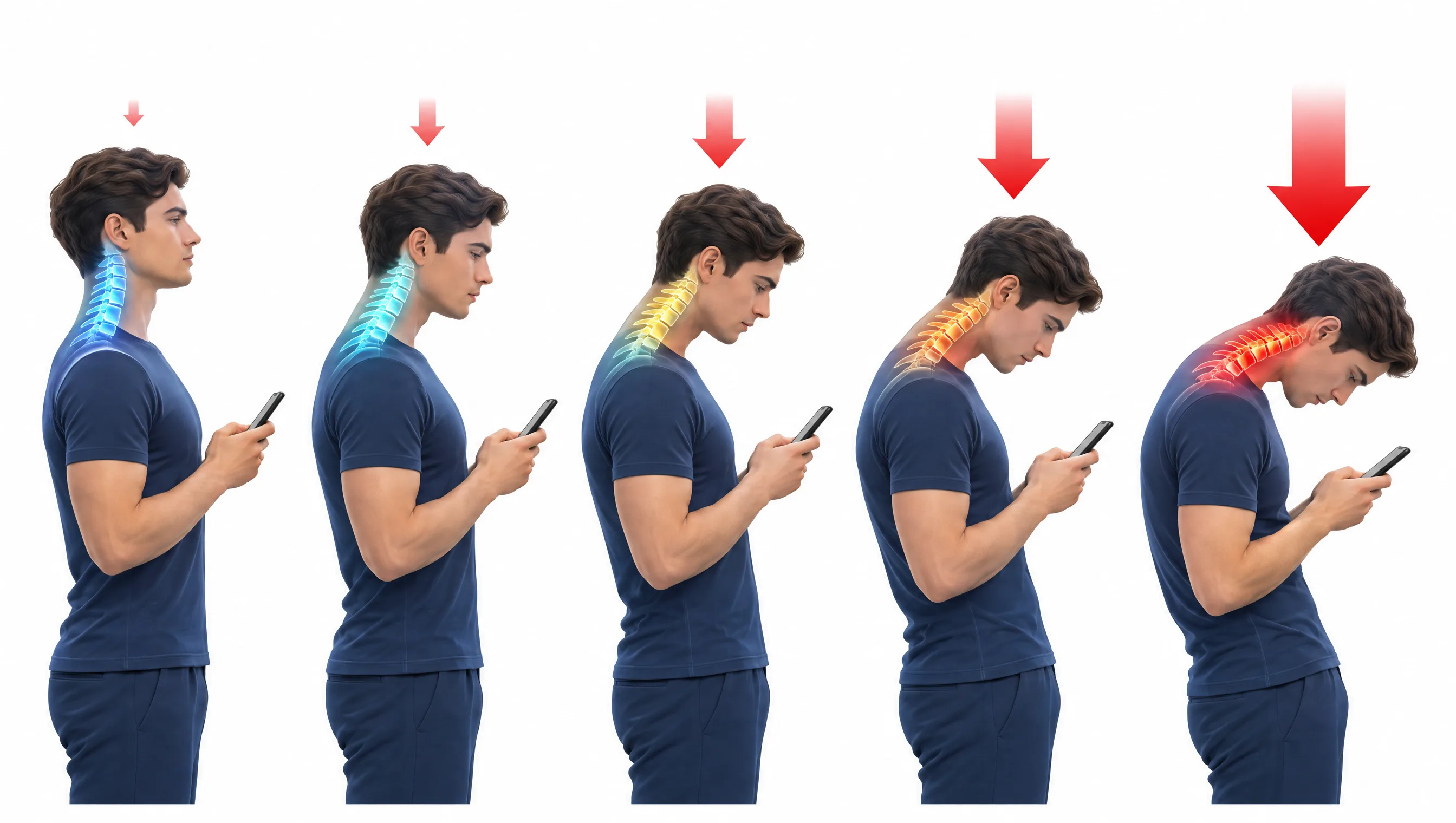
| Head position | Effective load on the neck | Source |
|---|---|---|
| Upright (0°) | 10 to 12 lbs | Hansraj, 2014 |
| Tilted 15° | 27 lbs | Hansraj, 2014 |
| Tilted 30° | 40 lbs | Hansraj, 2014 |
| Tilted 45° | 49 lbs | Hansraj, 2014 |
| Tilted 60° | 60 lbs | Hansraj, 2014 |
The same paper estimated that people spend two to four hours a day with their heads tilted over phones and devices. That adds up to 700 to 1,400 hours a year of extra stress on the neck. Dr. Hansraj warned that this load may lead to early wear and tear on the spine over time.
One caution: these are model estimates, not measurements from patients. They show the direction of the problem clearly, but they do not prove that phone use alone causes neck pain. Long hours at a desk, poor sleep positions and old injuries all play a part too. If your neck pain started after a crash, the clinic's whiplash injury statistics page covers that side of the story.
Does neck pain go away on its own?
Many people expect neck pain to clear up and never return. The research says otherwise. The Bone and Joint Decade 2000 to 2010 Task Force on Neck Pain reviewed decades of studies and reached a few clear conclusions.
- Most people with neck pain do not have their symptoms go away completely.
- Between 50% and 85% of people who have neck pain will report it again 1 to 5 years later.
- Among workers, 60% to 80% still reported neck pain one year later.
- Workers who did general exercise and sports were more likely to improve.
- Without trauma or warning signs, routine X-rays or MRIs are usually not needed.
In other words, neck pain behaves more like a condition that flares up and settles down than a one-time event. That is why care at Neck & Back Pain Specialists focuses on both relief now and fewer flare-ups later. If you have never been to a chiropractor, the what to expect on your first visit page walks through the exam step by step.
What the numbers say about prevention
The data points to a few habits that make a real difference. Raising screens to eye level cuts the forward head tilt that drives the text neck numbers. Regular movement and exercise were linked to better recovery in the Task Force research. Breaking up long sitting sessions keeps neck muscles from locking into one position for hours.

When to get help
See a professional if neck pain lasts longer than a week or two, keeps coming back, or comes with headaches, arm numbness or tingling. Those signs can point to an irritated nerve or a herniated disc. At the Fountain Valley clinic, care plans may include chiropractic adjustments, spinal decompression, massage therapy, acupuncture and therapeutic exercise to build lasting neck strength. Neck strain from the job is also common, and the work injury care page explains how those cases are handled.
What this means in plain English
- About 1 in 6 American adults has had neck pain in the last three months.
- Women and people in their mid-40s to mid-70s get it the most.
- Looking down at a phone can make your neck carry up to five times the weight of your head.
- Neck pain often comes back, so building strength and better habits pays off.
- Pain that lingers, returns or spreads into the arm is worth having checked.
Frequently asked questions
How common is neck pain in the United States?
Very common. CDC survey data from 2018 shows that 15.7% of U.S. adults had neck pain in the past three months. That is about 1 in 6 adults.
Who gets neck pain the most?
Women report neck pain more often than men, both in the U.S. and worldwide. Rates are also highest between ages 45 and 74, and higher among adults with lower family incomes.
How much does your head weigh on your neck when you look at a phone?
An upright adult head puts about 10 to 12 pounds on the neck. A 2014 spine model estimated that tilting forward 15° raises that to 27 pounds, and tilting 60° raises it to about 60 pounds.
Is neck pain becoming more common?
The rate per person has stayed about the same since 1990, but the total number of people with neck pain keeps rising because the population is growing and aging. Cases are projected to reach 269 million worldwide by 2050.
Will my neck pain come back?
It might. Research from the Neck Pain Task Force found that 50% to 85% of people with neck pain report it again within 1 to 5 years. Staying active and fixing posture habits can help lower that risk.
Do I need an X-ray or MRI for neck pain?
Usually not. Without trauma or warning signs such as fever, weight loss or worsening weakness, routine imaging is generally not needed. A hands-on exam is often enough to guide care.
Sources
- Centers for Disease Control and Prevention, National Center for Health Statistics. Summary Health Statistics: National Health Interview Survey, 2018, Table A-5a.
- GBD 2021 Neck Pain Collaborators. Global, regional, and national burden of neck pain, 1990 to 2020, and projections to 2050. Lancet Rheumatology, 2024.
- Hansraj KK. Assessment of stresses in the cervical spine caused by posture and position of the head. Surgical Technology International, 2014.
- Bone and Joint Decade 2000 to 2010 Task Force on Neck Pain and Its Associated Disorders. Spine, 2008.
- National Center for Complementary and Integrative Health (NIH). Analysis of musculoskeletal pain in the 2012 National Health Interview Survey.

Dr. Ed Balta, DC
Neck & Back Pain Specialists · Fountain Valley, CA
Dr. Ed Balta earned his degree from Los Angeles College of Chiropractic and has treated neck and back pain in Orange County for more than 30 years. Desk workers, parents, athletes and retirees all come to him with stiff, aching necks. He focuses on finding what keeps the pain coming back and gives each patient simple steps to use at home.