





Whiplash Injury Statistics 2026: Crash Data, Recovery Time and Local Numbers
The short answer
Whiplash is one of the most common injuries from car crashes in the United States. Federal crash data shows that about 1 in 8 people in a rear-end crash ends up with a neck injury, and neck sprains and strains are the most frequently reported injury in U.S. auto insurance claims. Most people improve within a few months, but research suggests roughly half still have some neck pain a year later, which is why early care matters.
This page pulls together the most useful whiplash injury statistics from federal crash research, insurance safety data, peer-reviewed studies and California traffic records. Each number lists its source so you can check it or cite it. If you were recently hurt in a crash, the team at Neck & Back Pain Specialists explains what to do next on the whiplash treatment page.
National whiplash statistics
The clearest national picture comes from a 2023 report by the National Highway Traffic Safety Administration (NHTSA). Researchers studied police-reported tow-away crashes from 2000 to 2015 to see how often rear-end crashes hurt the neck and whether newer head restraints helped.
| Statistic | Figure | Source |
|---|---|---|
| Share of crashes that were rear-end crashes | About 25% | NHTSA, DOT HS 813 504 (2023) |
| Occupants in rear-end crashes with a cervical spine (neck) injury | 12.42% | NHTSA, DOT HS 813 504 (2023) |
| Estimated occupants with neck injuries in rear-end crashes, 2000 to 2015 | 1,010,270 | NHTSA, DOT HS 813 504 (2023) |
| Drop in neck injury risk with upgraded FMVSS 202a head restraints | 11.1% | NHTSA, DOT HS 813 504 (2023) |
| Most frequently reported injury in U.S. auto insurance claims | Neck sprains and strains | Insurance Institute for Highway Safety (IIHS) |
| Drop in injury claim rates with good-rated seats and head restraints | 11% | IIHS |
You can read the full federal report, Evaluation of Upgraded Head Restraints (NHTSA), for the complete method and tables.
Who is most at risk
Not every crash or every person carries the same risk. The NHTSA analysis found two factors that stood out clearly.
Higher odds of neck injury in rear-end crashes
Source: NHTSA, DOT HS 813 504 (2023). Odds ratios of 1.651 and 1.428.
Women made up about 60% of the injured occupants in that data. Researchers often point to differences in neck size, muscle mass and seated position as possible reasons. A crash that hits the full rear of a car, rather than a corner, also transfers more force straight through the seat and into the neck.
Speed is only part of the story. Many people with whiplash were in what looked like minor fender benders. If your neck feels stiff after a low-speed bump, the guide on what Fountain Valley drivers should know after a car accident walks through the first steps.
Whiplash recovery time statistics
The question most patients ask is how long whiplash lasts. Studies agree that most people get better, but recovery is slower and less complete than many expect.
| Time after injury | Still had symptoms | Recovered | Source |
|---|---|---|---|
| 3 months | 44% | 56% | Radanov et al., 117 patients |
| 6 months | 31% | 69% | Radanov et al., 117 patients |
| 12 months | 24% | 76% | Radanov et al., 117 patients |
| 1 year (pooled research) | About 50% report neck pain | About 50% | Bone and Joint Decade 2000 to 2010 Task Force |
Share of patients still with symptoms
Source: Radanov et al., prospective study of 117 whiplash patients.
The Task Force review also found that people with more pain, more symptoms and more trouble doing daily tasks right after the crash tend to recover more slowly. That makes the first few weeks an important window. Gentle movement and guided care usually work better than long rest in a neck collar.
What can help recovery
At Neck & Back Pain Specialists, whiplash care is built around each patient's exam. Depending on the findings, a plan may include chiropractic adjustments, massage therapy for tight muscles, cold laser therapy, electrical stimulation and therapeutic exercise to rebuild neck strength. Crash injuries can also show up as headaches, back pain or a disc herniation, so the exam checks more than the neck.
Fountain Valley crash numbers
The California Office of Traffic Safety (OTS) tracks how many people are killed or injured in crashes in each city. Fountain Valley sits between the 405 freeway, Brookhurst Street and Warner Avenue, so daily stop-and-go traffic is a fact of life here.
Fountain Valley: people killed and injured in crashes
Source: California Office of Traffic Safety, Crash Rankings, Fountain Valley (2019 to 2023).
The 2023 total is the lowest of the five years shown, which is good news. Still, that is more than four people a week in one small city. The latest local figures are on the OTS Fountain Valley crash rankings page. OTS also reported 44 speed-related injury and fatal crashes in Fountain Valley that year.
What this means in plain English
- Rear-end crashes are common, and about 1 in 8 people in them hurts their neck.
- Women and people hit squarely from behind are more likely to be injured.
- Most people recover, but about 1 in 4 still had symptoms after a year in one study.
- Small dents can still mean real neck injuries, so get checked even after a minor crash.
- Starting care early is linked to better recovery, so it pays to book a whiplash exam soon after a crash.
Frequently asked questions
How common is whiplash after a car accident?
Very common. NHTSA data shows about 12.4% of people in rear-end crashes had a neck injury, and IIHS reports that neck sprains and strains are the most frequently reported injury in U.S. auto insurance claims.
How long does whiplash take to heal?
Many people feel better within weeks to a few months. In one study of 117 patients, 56% had recovered by 3 months and 76% by 12 months. Pooled research suggests about half of people still have some neck pain at one year.
Can you get whiplash from a low-speed crash?
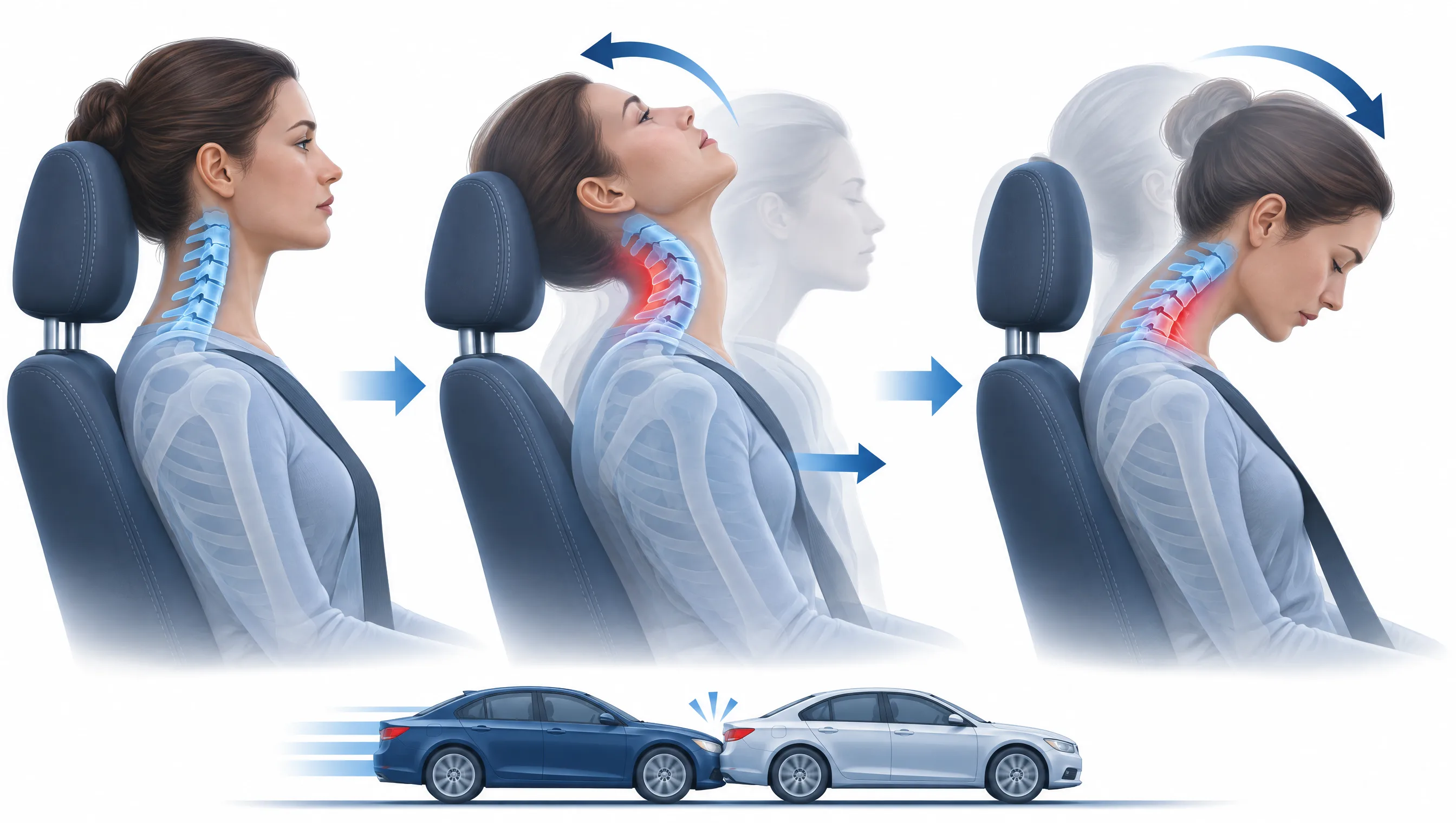
Yes. The neck can bend into an S-shape in a fraction of a second even when car damage is small. That is why symptoms like stiffness, headaches or arm tingling should be checked after any rear-end crash.
Why do symptoms sometimes show up a day or two later?
Adrenaline after a crash can mask pain, and inflamed muscles and ligaments often stiffen over the next 24 to 72 hours. Delayed pain is common and is still worth having examined.
Do head restraints really reduce whiplash?
Yes. NHTSA estimated an 11.1% drop in neck injury risk with upgraded head restraints, and IIHS found 11% lower injury claim rates with good-rated seat and head restraint designs. Adjust yours so the top is level with the top of your head.
Does insurance cover whiplash treatment in California?
Often, yes, through auto insurance medical payments coverage or a claim against the at-fault driver. The insurance and payment page explains the options the clinic accepts.
Sources
- National Highway Traffic Safety Administration. Evaluation of Upgraded Head Restraints: FMVSS 202a. DOT HS 813 504, October 2023.
- California Office of Traffic Safety. Crash Rankings: Fountain Valley, 2019 to 2023.
- Insurance Institute for Highway Safety (IIHS). Head restraint and whiplash research.
- Carroll LJ, et al. Course and prognostic factors for neck pain in whiplash-associated disorders. Bone and Joint Decade 2000 to 2010 Task Force on Neck Pain, Spine, 2008.
- Radanov BP, et al. Long-term outcome after whiplash injury: a 2-year follow-up of 117 patients.

Dr. Ed Balta, DC
Neck & Back Pain Specialists · Fountain Valley, CA
Dr. Ed Balta graduated from Los Angeles College of Chiropractic and has cared for Orange County families for more than three decades. Many of his patients come in after auto injuries with neck pain, headaches or stiffness. He explains every exam finding in plain words and shapes each care plan around how the patient is healing.